Search Results

Computer Labs Hours

Resources for:
icon Close

Fall 2026

Computing Services has multiple computer labs in our
New Jersey Campuses for classroom instruction and student use.

*Lab hours may vary. Visit our Instagram > for the latest lab hours.

Computing Services Instagram QR Code
close

Florham Campus

Dreyfuss Building
RoomMonTueWedThurFriSatSun
Dreyfuss
Building
8AM-
11PM
8AM-
11PM
8AM-
11PM
8AM-
11PM
8AM-
5PM
10AM-
5PM
12PM-
9PM
Dreyfuss
212, 213
8AM-
11PM
8AM-
11PM
8AM-
11PM
8AM-
11PM
8AM-
5PM
10AM-
5PM
12PM-
9PM
Dreyfuss 21110PM-
1AM
10PM-
1AM
10PM-
1AM
10PM-
1AM
10PM-
1AM
12PM-
5PM
12PM-
5PM

Computer Labs

  • D206
  • D207
  • D208
  • D209

Laptop Work Stations
(Monitors Only)

  • D212
  • D213

Animation Lab

  • D211
close
Zen Building
RoomMonTueWedThurFriSatSun
Zen
110, 242
8AM-
8PM
8AM-
8PM
8AM-
8PM
8AM-
8PM
8AM-
8PM
10AM-
5PM
12PM-
5PM

Phone:

(973)-443-8689

close

Metropolitan Campus

Dickinson Hall – Hackensack
RoomMonTueWedThurFriSatSun
Dickinson
Hall
8AM-
11PM
8AM-
11PM
8AM-
11PM
8AM-
11PM
8AM-
5PM
CLOSEDCLOSED

Rooms:

  • Lab A (DH2163)
  • Lab B (DH2164)
  • Lab C (DH2165)

Phone:

(201)-692-7111

close
University Hall – Teaneck
RoomMonTueWedThurFriSatSun
University Hall8AM-
11PM
8AM-
11PM
8AM-
11PM
8AM-
11PM
8AM-
5PM
10AM-
6PM
2PM-
10PM

Rooms:

  • Front Lab (UH 22)
  • Back Lab (UH 28)

Phone:

(201)-692-7112

*Temporarily Closed

The UHall Side lab is currently closed to Students and Faculty for the fall semester for internal use.

Dickinson Hall Lab C is always available to students during lab hours.

close
Student Union Building – Teaneck

Rooms:

  • Multipurpose Room 135

Phone:

(201)-692-2222

Tip

The Student Union Building Multipurpose Room will be locked at all times. To gain access to the Student Union Building computer lab, you will need to contact Public Safety at (201)-692-2222.

close

Note

Computer Lab hours of operation are subject to change based on utilization throughout the semester. Lab computers are available on a first-come-first-serve basis unless reserved for classes. Class reservations are posted at the lab entrances.

Last Modified:

Printing in The Computer Labs

Resources for:
icon Close

Cost and Billing

To prevent excessive printing, the Department of Computing Services charges students a small fee for printing in the FDU Computer Labs. Black and white printing costs $0.05 per page and color printing is $0.25 per page.

Each student pays a technology fee which includes $10.00 of lab printing for each of the fall, spring, and summer semesters. Printing charges above the $10.00 per semester will appear as a Printing Fee on the next tuition bill.  

The $10 per semester printing credit is a standard allotment that expires each semester and has no cash value. No refunds will be given for pages not printed and unused prints for each semester’s allotment do not carry forward.

FDU staff and faculty members can use lab printers on a limited basis without charge for the purpose on conducting FDU business. Please use your department’s printer(s) as your primary printing resource. Faculty and staff members are limited to 200 pages per semester. Any attempt to print past this quota will result in an error message stating that the account does not have enough credit.

Note: You are responsible for all activity on your account. If you share your password with others or forget to log out, you will be held responsible for any activity done via your account, including printing charges. Computing Services strongly recommends that you use non-trivial passwords and log out completely before leaving a workstation.

View and Manage your Lab Printing

PaperCut Icon
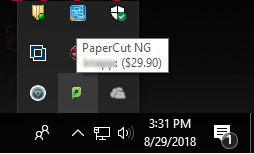
  1. Hovering your cursor on the Papercut tray icon shows the Balance
  1. When you click on the Papercut tray icon, it opens a new window as seen below:
  1. Clicking on the “Details…” button on the lower right of the Balance within the Papercut window opens a web browser that will let the user log in and see their job history

Receiving Credit for Printing Errors

Credit will be given for errors caused by the printer (paper jams, toner problems, etc.) In such situations, please take the bad printouts to a Lab Assistant in Dreyfuss, Dickinson Hall, or University Hall. Your information will be taken, and reimbursement will be made in the form of a credit applied to your total charge for the semester. Situations which could have been prevented before printing, such as extra blank pages at the end of a document, will not be reimbursed.

Can I Use My Own Paper in These Printers?

No. Jobs are printed as they are received. There is the possibility that after loading the printer with your paper someone will print a job that will then be printed out on your paper. Transparencies and mailing labels are not allowed in the lab printers due to the high heat that laser printers use and the potential for damage to the equipment.

Last Modified:

Software Request Guidelines for University Computers and Computer Labs

Resources for:
icon Close

Departments wishing to obtain software, whether it is for use by the department or to be installed in the FDU computer labs and/or FDU Anywhere, should plan appropriately to provide adequate time to acquire the software and make it available to users.

The following steps should be used as a guide when planning to obtain software for instructional or business use:

Tip

Plan a minimum of 3 weeks for a contract review before a PO can be processed. See contract review requirements and order process by visiting the link at the bottom of the page.

  1. Selection of product
  2. Creation of Purchase Order (PO) and approval by department/dean/chair
  3. Technology review and approval by OIRT
  4. New vendor processing, if necessary
  5. Contract review
  6. Software purchase and delivery to FDU
  7. Software preparation. Plan up to 60 days to allow for items such as:
    • Creating configurations for FDU’s needs and environment
    • Setting up license servers or other required systems
    • Integration with other systems (e.g., Single Sign On)
    • Testing mass deployment (if for the computer labs)
    • Integration with FDU Anywhere (if needed) assuming the software is licensed and approved for VDI enviroment
  8. Testing and confirmation of proper functionality by the requestor (instructor)
  9. Final installation on computers

Note

Even if the software has no cost to FDU, per the Office of the General Counsel and the Contract Review Policy, if the software requires you to agree to terms and conditions, it’s an agreement that must be reviewed

Please begin by completing the Computing Services > Lab Reservation & Lab Software Request (Faculty & Staff NJ Only)

SAMI Forms

Last Modified:

Wired Network Requirements for Labs, Desktops, and Digital Displays

Resources for:
icon Close

Computing equipment in University computer labs, desktop computers assigned to employees or student workers, and all digital displays must connect to the FDU network through a wired (Ethernet) connection. This requirement applies across all departments and campuses. Laptop computers are not covered by this policy.

Why Wired Ethernet Is Required

University computer labs are provisioned for wired connectivity. Consistent performance and dedicated bandwidth help maintain standard system images, deliver software updates and security patches, and support sustained data transfers. Wireless connectivity does not meet these requirements for lab and desktop environments.

Wired and Wireless Connections

Wired Ethernet

A wired connection uses a physical Ethernet cable to connect a device to the network through a switch or router, which provides access to the internet.

Advantages

  • Typically faster and more consistent speeds.
  • Lower latency, which benefits real-time applications.
  • A wired connection is generally more secure because it is harder to intercept.
  • Unaffected by Wi-Fi congestion or radio interference.
  • Reliable for large file transfers and critical systems.

Tradeoffs

  • Requires physical cabling and is less flexible.
  • Cabling, labor, and infrastructure can make installation more costly.
  • Less convenient for mobile devices.
  • Equipment can be harder to move or reconfigure.

Wireless (Wi-Fi)

A wireless connection uses radio waves (Wi-Fi) to connect devices through a wireless access point to the network. These devices include laptops, phones, tablets, and Internet of Things (IoT) equipment.

Advantages

  • Mobility and flexibility within Wi-Fi range.
  • Can be easier to set up and expand.
  • No cable is needed at each device, reducing clutter.
  • Supports phones, tablets, laptops, and IoT devices.
  • Useful for guest access and temporary setups.

Tradeoffs

  • Speeds can be slower than wired connections and vary with the Wi-Fi standard and network load.
  • Higher latency can affect real-time applications.
  • Other devices and walls can interfere with a Wi-Fi connection.
  • Wireless connections can be less secure and more susceptible to eavesdropping if not properly secured.
  • Signal strength can vary with distance, creating weak-signal areas or dead zones.

Choosing the Right Connection

Wired is best when maximum speed, reliability, and security matter, especially for critical systems, large file transfers, and fixed workstations.

Wireless is best when mobility, flexibility, and convenience matter, especially for mobile devices, guests, temporary setups, and areas where running cables is impractical.

The Bottom Line

Both wired and wireless connections have a place. Modern networks often combine them to balance speed, security, flexibility, and coverage. At FDU, this general comparison does not change the requirement for labs, desktop computers, and digital displays covered by this policy: they must use wired Ethernet.

Requirements

  • Connect all lab computing equipment, including workstations, printers, and peripherals that require network access, through wired Ethernet.
  • Connect all desktop computers assigned to employees or student workers through wired Ethernet, regardless of location.
  • Connect all digital displays, including monitors in common areas, classrooms, and athletic venues, through wired Ethernet. Any ancillary device that requires internet access must also use a wired connection.
  • Do not use wireless connectivity in place of a required wired connection.

Exceptions

Any deviation, including a request to design or configure a lab or desktop environment for wireless connectivity, requires prior written approval from the Associate Vice President of Systems and Networking. Do not proceed with a wireless design or implementation until that approval is granted.

Cost of a Data Jack

The requesting department is responsible for the cost of providing an Ethernet data jack for an individual workstation.

Last Modified: