Academic Technology is under the Office of Information Resources and Technology. Our department administers and supports the Blackboard course management system, and any other software products of special use to the teaching and learning. OAT is also in charge of procuring and maintaining overhead data projectors and other technology enhancements to classrooms.
If you are scheduled to attend class using Zoom and you run into technical difficulties, here are some steps you can take.
Common Fixes for Zoom Connection Issues
Do. Not. Panic. This shift to distance learning is a sudden change. We will do everything we can to support your learning
Try your best to progress through the steps and troubleshooting resources below. Join when you are able. You can use the chat or hand-raising function once you join the class to let the faculty know if you have questions.
Try to exit Zoom and open it again
Try to restart your device and re-open Zoom
Check that you do not have pop-ups blocked. Also check that you have “allowed” the Zoom browser extension to operate, if needed
Try on a different device, if you have access to one. If you do not have access to a different device, proceed to step 6
If you still cannot access Zoom after taking these steps, please contact theSAMI Support Desk with a description of the problem (e.g., error message that you received). Please also bring the issue to the attention of your instructor so they can let you know what you missed in the class session that you were unable to attend
LockDown Browser is a specialized browser that secures the testing environment in Blackboard Learn. When students use LockDown Browser to take a test on Blackboard, they are prevented from printing, copying, navigating to other websites, accessing other applications, or closing the test until it is submitted for grading. Tests designed to work with LockDown Browser cannot be accessed using standard web browsers.
Windows 10 (including x86 32-bit and 64-bit processors and ARM 64-bit processors using x86 emulation), Windows 8, and Windows 7
2 GB RAM
200 MB of free Hard Disk space
Windows 10S
Windows 10S is not a compatible operating system.
macOS
macOS 10.12 to 10.15
2 GB RAM
200 MB of free Hard Disk space
iOS
iOS 11.0+
Older Operating Systems
LockDown Browser and Respondus Monitor may continue to run in older operating systems that have reached “end-of-life” but students may encounter unexpected results.
close
Setting up and Using Respondus LockDown Browser Monitor
Log into your course in WebCampus and deploy a test. This step is important, as you will not be able to use Respondus LockDown Browser unless you have created and deployed a test
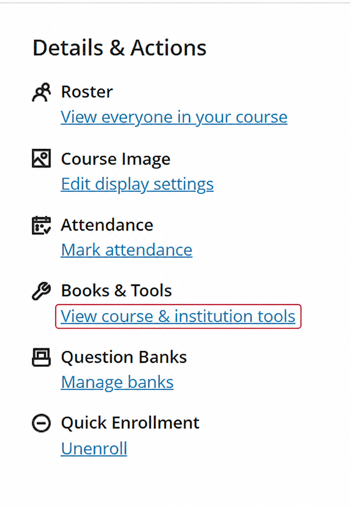
From the Course Details and Actions right-hand navigation menu under Books & Tools select View course & institution tools
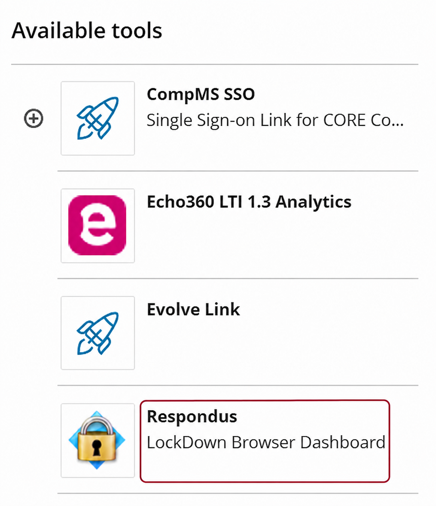
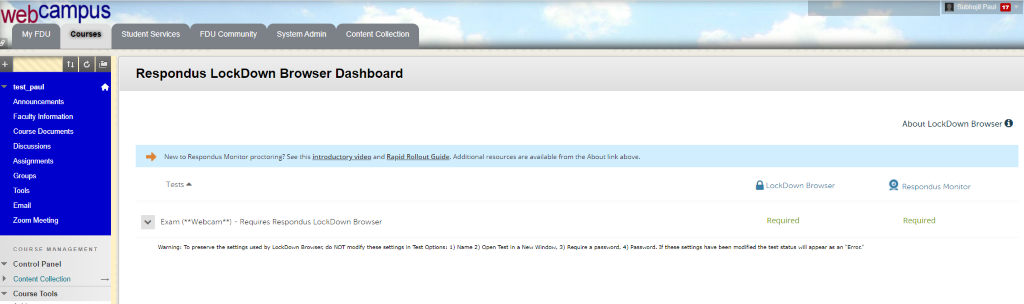
From Available Tools, select Respondus LockDown Browser Dashboard
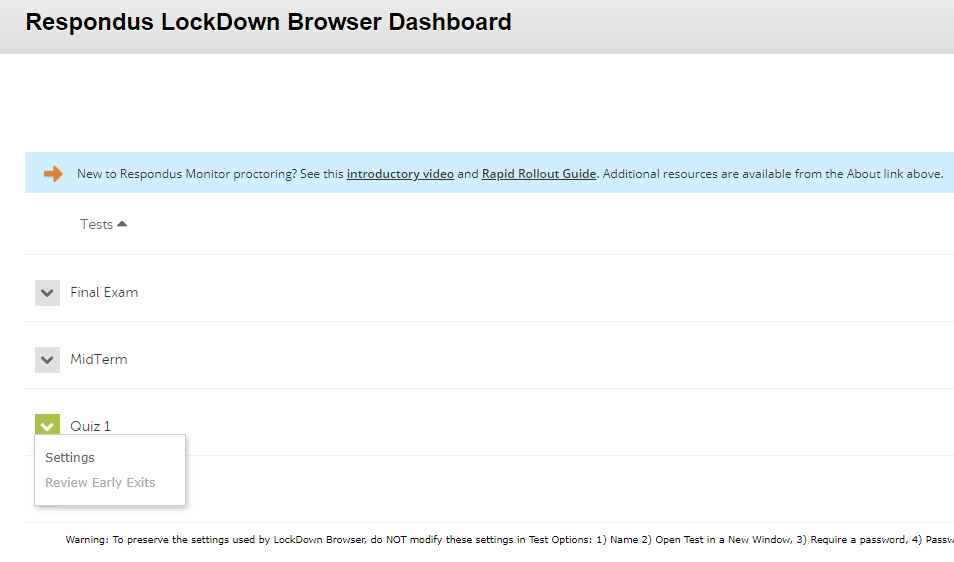
Click the arrow next to the exam you want to implement “Lockdown Browser” and click on “Settings”
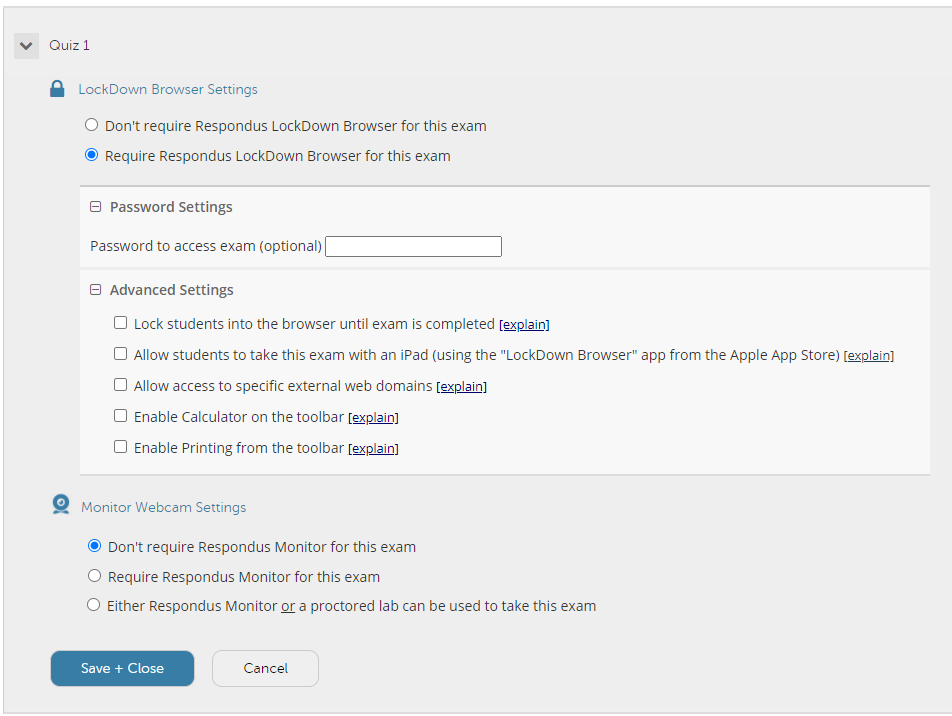
Click “Require Respondus LockDown Browser for this exam“
Click “Advanced Settings” and choose the options that you want to enable for the exam
The first setting will prevent students from exiting the browser until the exam is completed
The second setting will allow students to take the exam with an iPad, using the free LockDown Browser app
The third setting will allow students to access a list of specified web domains during the test
The fourth and fifth settings allow instructors to provide students with a calculator or print function in the LockDown Browser toolbar
Tip
For additional information, select the explain link that follows each setting
Click “Save and Close” to apply the settings
close
Respondus Monitor
Respondus Monitor is a webcam feature for LockDown Browser that records students during online, non-proctored exams. When this feature is enabled for a test, students are required to use a webcam and microphone with LockDown Browser. After the exam is complete, an instructor can review the details of the assessment, even the recorded videos.
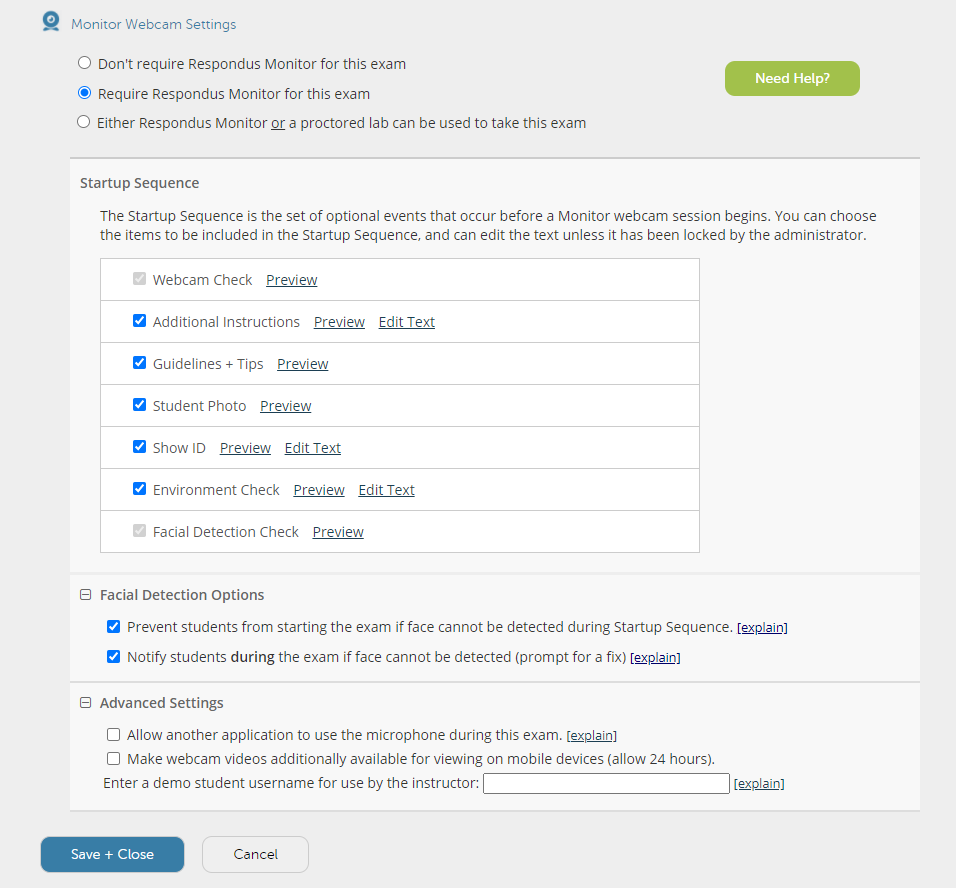
To give students the option to either take the exam with a webcam or in a proctored testing lab, select Either Respondus Monitor or a proctored lab can be used to take this exam. A test password will then be required to access the test in proctored settings.
Click “Respondus Monitor for this Exam“
Then select the items to be included in the “Startup Sequence”, the steps a student must complete before the start of an exam
Choose “Save and Close”
Your exam will now require the use of LockDown Browser and Respondus Monitor.
close
Installing the Chromebook Extension
LockDown Browser for Chromebook minimally requires the version of ChromeOS that Google makes available via their Long Term Support (LTS) channel. For more information:
To install the new extension on a student-owned Chromebook, students must use the regular LockDown Browser installation link provided by your school. They will not be able to find the app by searching the Chrome Web Store directly. The installation link will redirect them to the Chrome Web Store, where they should select “Add to Chrome” to install the LockDown Browser extension.
A SharePoint library containing a series of MS Word tutorials intended to provide new and existing faculty with some basic guidance on using WebCampus to administer an online course.
Anyone with the link who is an FDU Faculty member and can sign on to Office 365 should be able to view these files. Adjunct faculty members should first visit the OERA “Faculty Resources” SharePoint site and request access.
Files are arranged in a logical sequence from “top to bottom”, but faculty can browse the “Description” column to locate documents that address specific needs.
Screenshots of “sample” Blackboard materials as well as links to a selection of supplemental videos and other resources from Blackboard’s Help site are included.
DSL or Broadband (high-speed) Internet connection with a consistent minimum speed of 2 Mbps
Broadband (high-speed) Internet connection with a speed of 4 Mbps or higher
Java
Java may be necessary to use Blackboard
close
Installing the Chromebook Extension
LockDown Browser for Chromebook minimally requires the version of ChromeOS that Google makes available via their Long Term Support (LTS) channel. For more information:
To install the new extension on a student-owned Chromebook, students must use the regular LockDown Browser installation link provided by your school. They will not be able to find the app by searching the Chrome Web Store directly. The installation link will redirect them to the Chrome Web Store, where they should select “Add to Chrome” to install the LockDown Browser extension.
Zoom experts host free and interactive live training webinars daily. Get up to speed in less than an hour. Please select the time zone that fits best for you when registering for one of our live training webinars.
Fairleigh Dickinson University has designated Zoom Rooms that support hybrid in-person and remote learning. On this page, you will find links to the locations of Zoom Rooms on both New Jersey campuses, instructions for using the Zoom Rooms, and details about the equipment for installed rooms, cart rooms, and connecting with ITV rooms.
Zoom is a web-based video conferencing tool that allows users to meet online, with or without video. Zoom users can choose to record sessions, collaborate on projects, and share or annotate on one another’s screens, all with one easy-to-use platform. It offers quality video, audio, and a wireless screen-sharing performance across Windows, macOS, Linux, iOS, and Android. Zoom has a feature-rich, mobile app for both iOS and Android, allowing you to virtually connect from anywhere with an Internet connection.
Zoom on Web Redesign
The Zoom website at fdu.zoom.us is being redesigned starting August 26, 2026. The Zoom Workplace app is not changing. See Zoom’s Introducing the new Zoom Web experience for what is moving and where to find it.
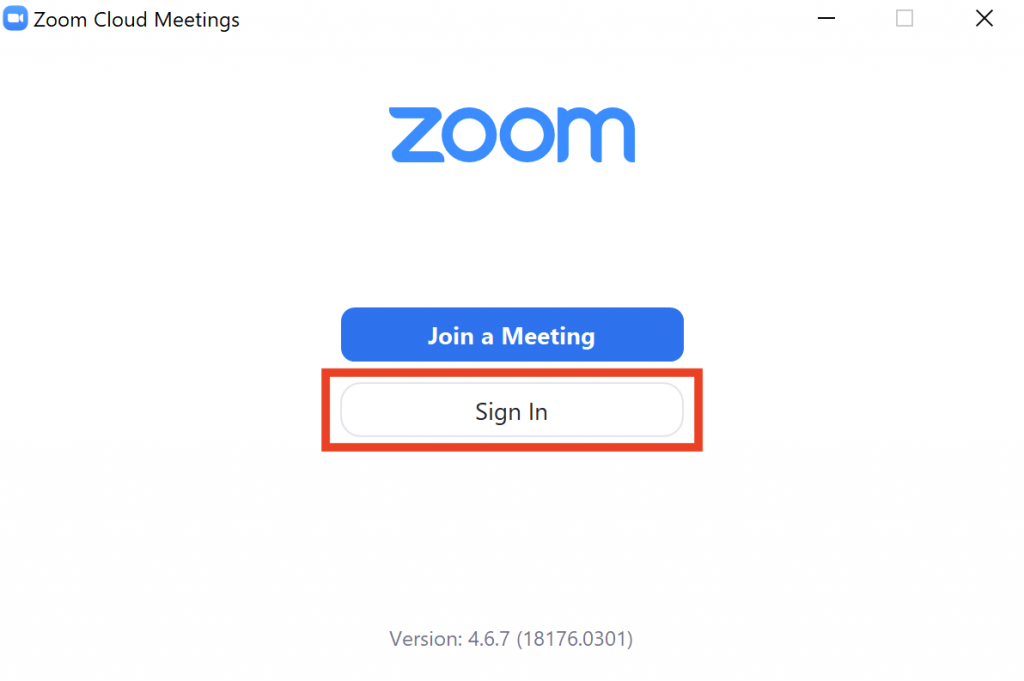
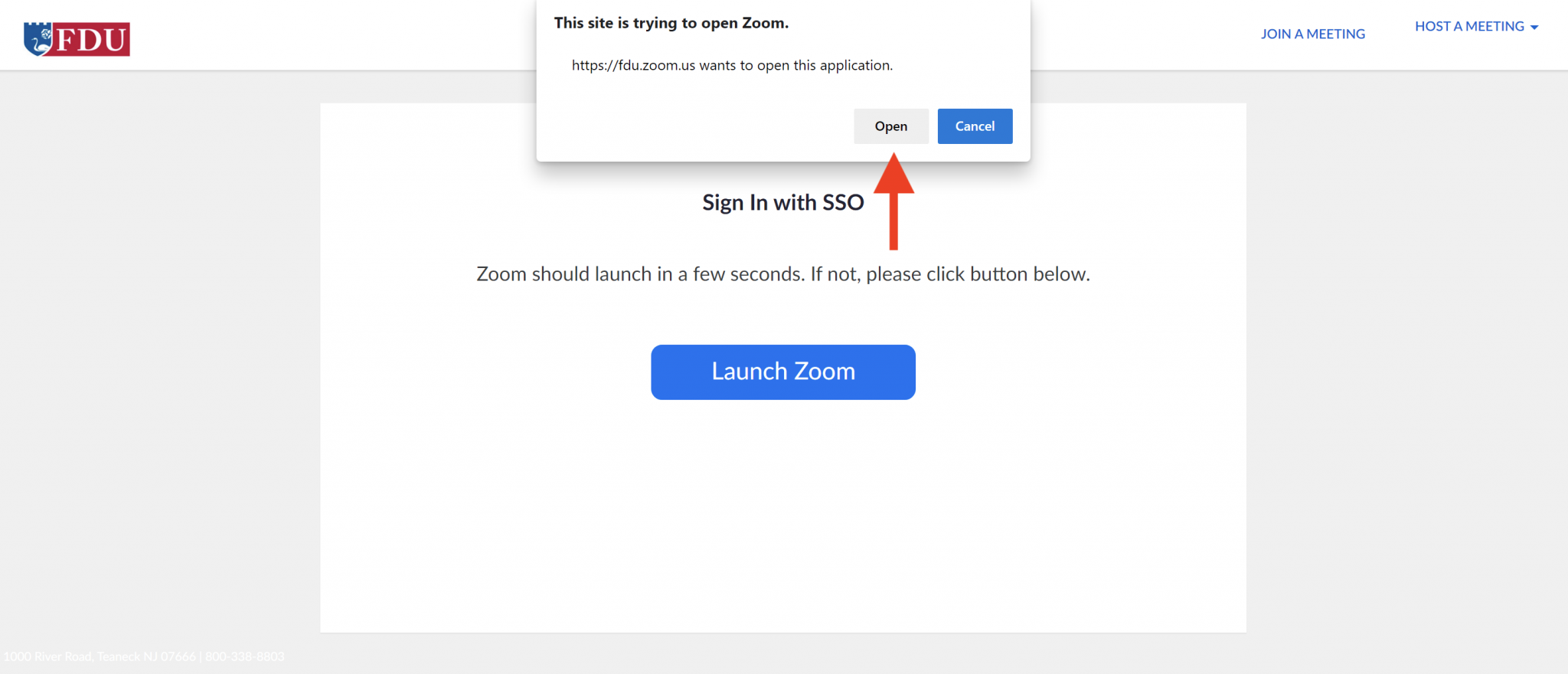
Once downloaded, you can go to the Zoom folder in your “START” menu and click “Start Zoom” on a PC or click on the “Zoom.us” app located in the applications folder on a Mac. Alternatively, you can open the application by searching for Zoom in your computers search bar.
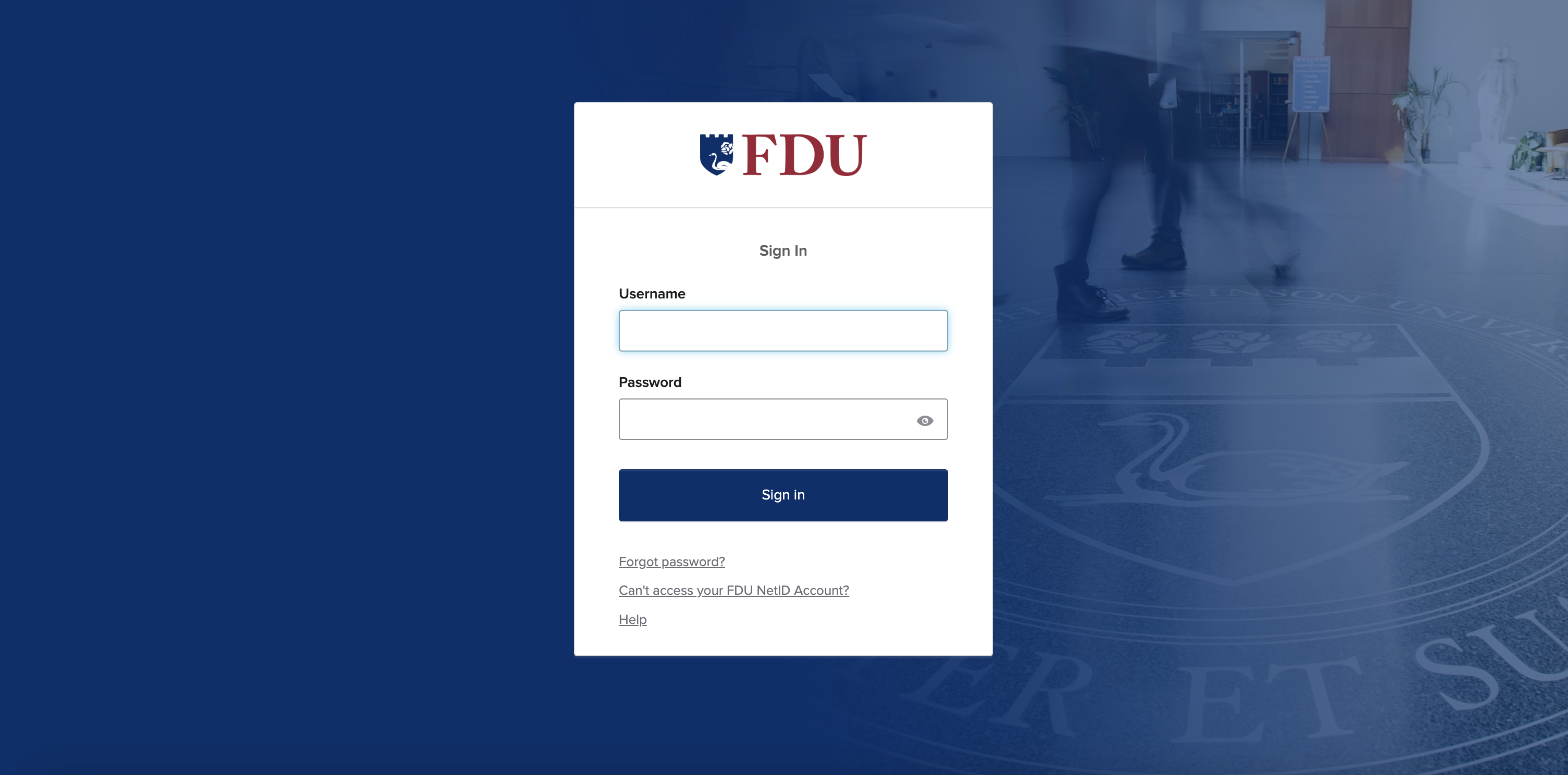
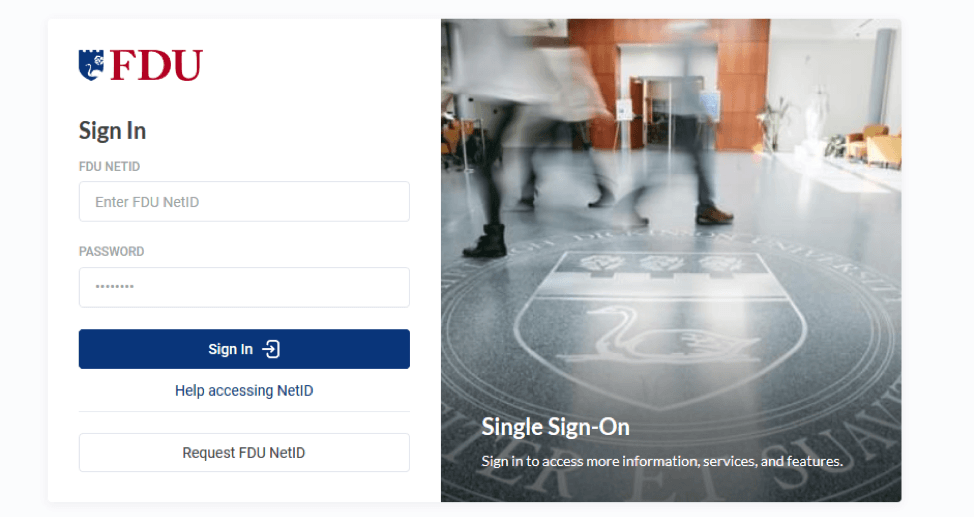
Click on “Sign In” at the top-right corner of the page and type your FDU NetID credentials
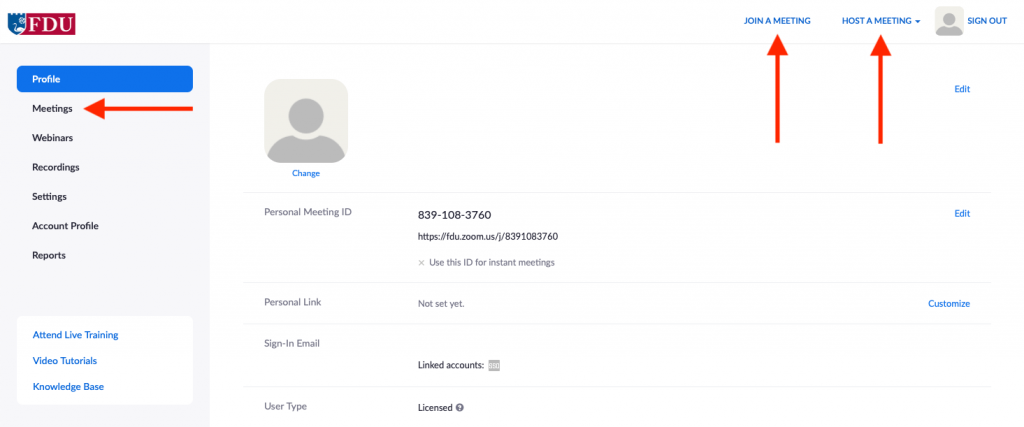
After logging in, you will see your profile information.
Joining a meeting – Click on the link and enter the meeting ID number provided by the host.
Hosting a meeting – You can host a meeting with or without video. Click on the option that you need and the meeting should start automatically.
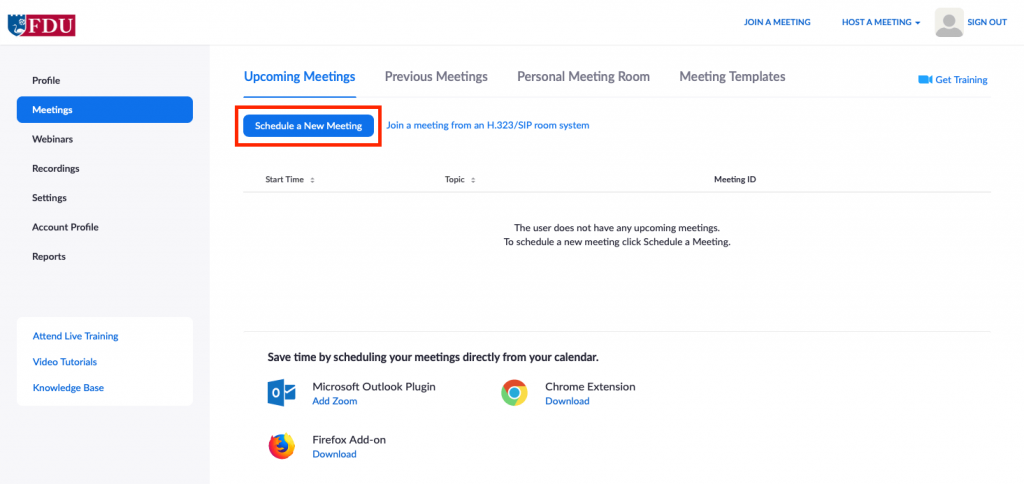
Scheduling a meeting – Click on Meetings on the left navigation area and then click on Schedule a New Meeting.
close
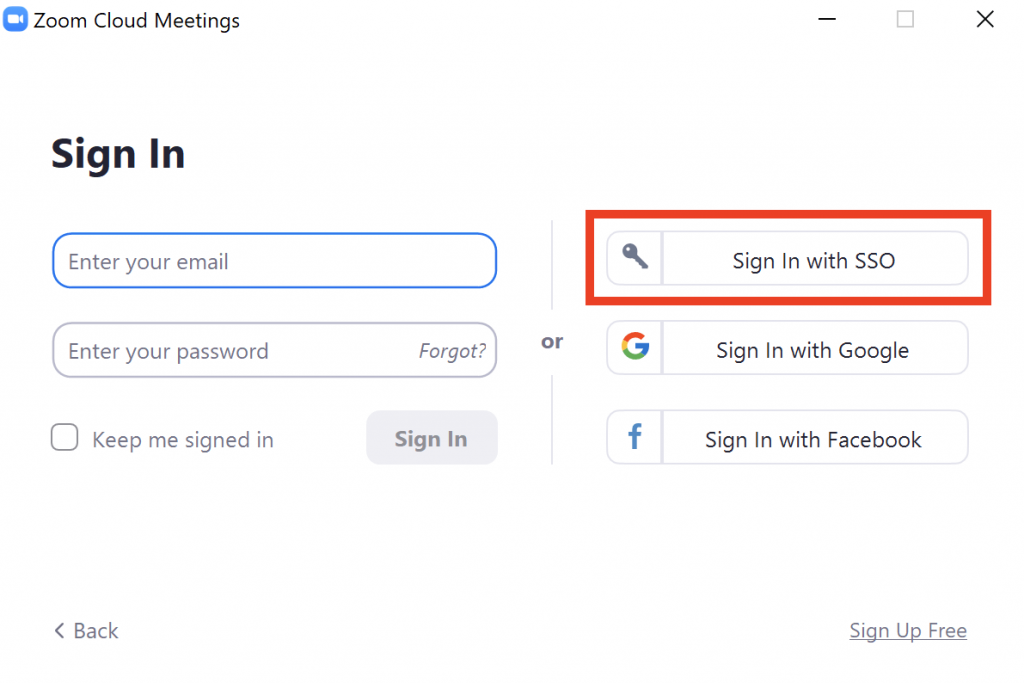
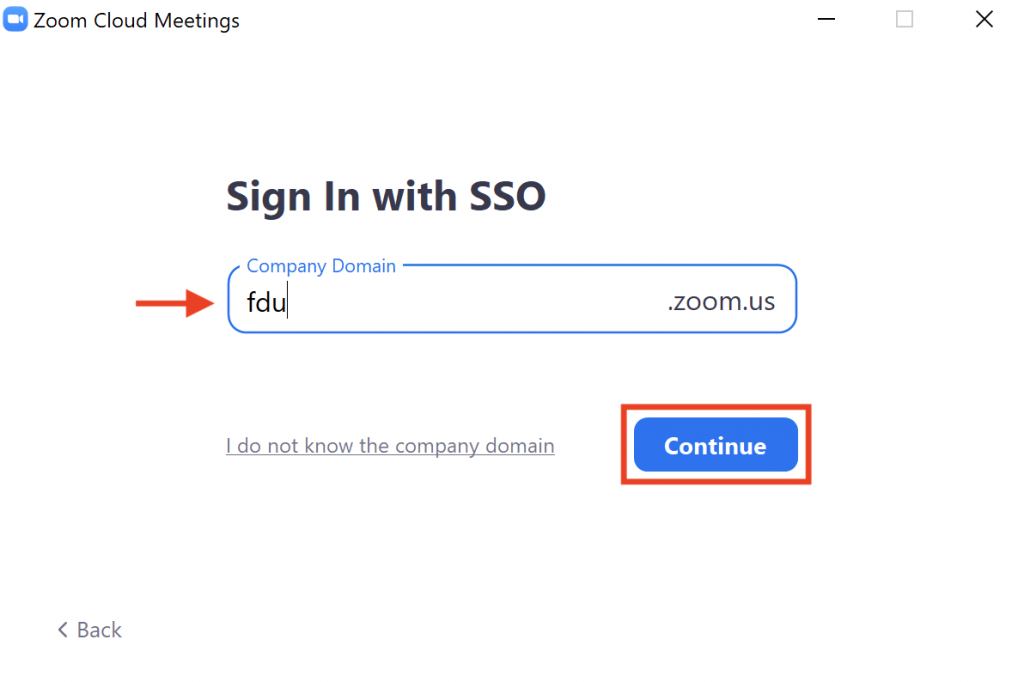
Installing the Zoom Native Client
The following steps are for users who have already downloaded the Zoom desktop client or are planning to use the client. These instructions are NOT for users who will be using the web browser to participate in a Zoom meeting.
To get the most out of your Zoom experience at FDU, visit Zoom’s official support site to learn how to join meetings, connect to audio, turn on your video, use virtual backgrounds, share your screen, chat with others, and view captions. These tools help you fully participate in classes, meetings, and virtual events.
Although we can lend some accessories to full time faculty and staff, it is impossible to anticipate all the various configurations that everyone may have so we suggest you purchase your own adapters that will enable you to plug your device into either a standard HDMI port or VGA port.
Ideally, we recommend contacting the SAMI Service Desk as we are not always at or office and our availability can change at a moment’s notice. If you are having issues with our equipment and need immediate assistance, the service desk can provide assistance via SAMISupport.fdu.edu. The support team will escalate to us as needed.
We provide projectors and screens, microphones (where applicable) speakers, and Video cables (HDMI or VGA). Please bring any cables/adapters that you use for your device as it is impossible to meet all possible configurations and we may not have the equipment necessary to display video from your device. We do not provide computers, furniture or power cables/strips of any kind.
Make sure all cables are in the correct ports and all usage instructions are followed. If those steps do not fix your issue you can contact the SAMI Service Desk via SAMISupport.fdu.edu for assistance or call 973-443-8822.
Manish WadhwaAcademic TechnologyAssociate Provost for Academic Applications and Technology
To access Forms, you will be directed to our SAMI Support Portal where you will be asked to log in using your NETID and authenticate using Duo. Once you click “Next,” you will be forwarded to samisupport.fdu.edu in a new window or tab.



 Feedback
 Copy Link




 Email
Email 


